
REFERENCE
Exosome Therapy
(Stem Cell Culture Supernatant)
Reference information on exosome therapy offered at veterinary clinics in Japan.

This page provides reference information on a therapy performed at veterinary clinics in Japan. It is not one of Scarecrow's supplement products. The therapy is offered at the clinics in Japan listed below; for whether it is suitable for your pet and what it involves, please consult the veterinarians at those clinics.
What Are Exosomes?
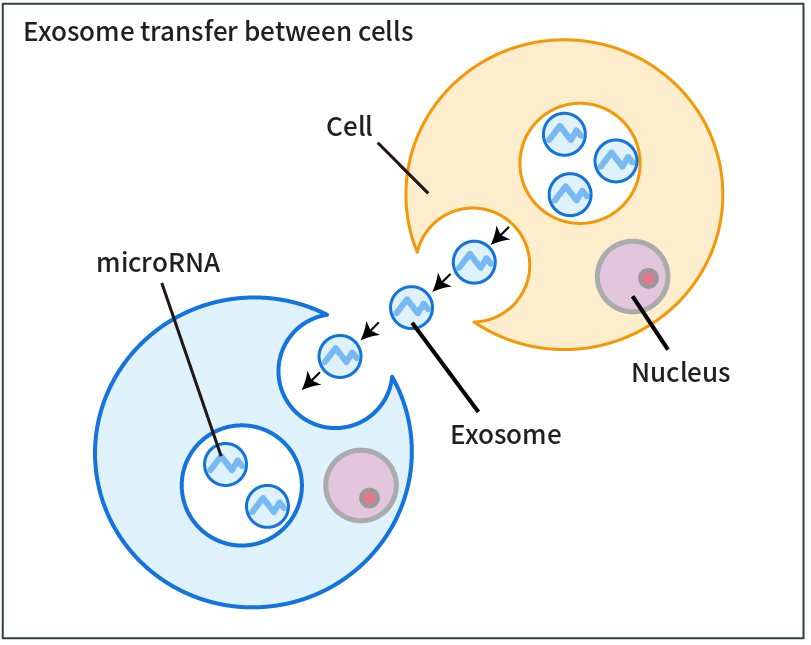
Exosomes are tiny extracellular vesicles (capsule-like particles) that are produced inside virtually every cell in the body and released by those cells. Exosomes carry a variety of substances, such as proteins and mRNA, that act as messengers.
In human medicine as well, treatments and research that make use of exosomes are advancing.
Stem Cell Supernatant vs. Stem Cell Culture Supernatant
Exosomes released outside cells circulate widely in body fluids, including the blood. It is known that when another cell takes up a circulating exosome, it is influenced by the messenger substances it contains and various responses follow. "Stem cell culture supernatant," which is rich in these exosomes, is a new medical technology whose potential is drawing attention.
Stem cells are cells that can differentiate into many types of cells and are involved in development and regeneration; the well-known iPS cells are one type of stem cell. Regenerative medicine, which has been in the news in recent years, attempts to repair damaged tissue by transplanting such stem cells into the affected area.
When stem cells are prepared, a liquid called "stem cell supernatant" is obtained. However, the cells collected are not enough on their own for use in regenerative medicine, so they are cultured to increase their number. The culture medium left over after the cultured stem cells are removed is the "stem cell culture supernatant."
Characteristics of Stem Cell Culture Supernatant
Stem cells produce a range of bioactive substances, including exosomes and cytokines, so stem cell culture supernatant is rich in these substances.
Administering stem cells themselves requires careful transplant immunology testing, whereas stem cell culture supernatant contains no cells, so there is considered to be less need to account for immune reactions such as rejection.

What effects can be expected is still being researched in both human and veterinary medicine. Please ask the veterinarians at the clinics below about indications and what to expect.
How the Therapy Is Performed
Exosome (stem cell supernatant) therapy normally requires an expensive cell culture system for regenerative medicine: fat cells are collected from the pet and used to produce a mesenchymal cell conditioned culture supernatant.
Instead, exosomes (conditioned culture supernatant) made from the umbilical cords of dogs and cats are sourced from RMDC Co., Ltd. in Japan. Using these for dogs and cats reduces the burden on the pet, as there is no need for anesthesia to collect tissue.
In addition, fat cells collected from dogs and cats of a certain age yield exosomes cultured from cells that have aged. The supernatant, by contrast, is made from umbilical cord cells (Wharton's jelly) of animals under one year old, which is one of its characteristics.
Stem cell culture supernatant can be given in several ways, including intravenous drip, local injection, intra-articular injection and topical application.

Clinics in Japan Offering Exosome Therapy
The following veterinary clinics in Japan offer this therapy.
- Nagano, Japan Sasaki Animal Hospital 佐々木動物病院 officesasaki.co.jp
- Fukuoka, Japan Seven Days Animal Hospital セブンデイズ動物病院 sevendays.or.jp/clinic
- Ibaraki, Japan Animal Hospital Doctor Kvet 動物病院Doctor Kvet pet-med.org/Dr.Kvet
- Hyogo, Japan Fujiwara Animal Hospital フジワラ動物病院 fujiwara-ahp.com
- Ishikawa, Japan Tobita Animal Hospital とびた動物病院 tobita-animalhospital.jimdofree.com
- Kyoto, Japan Kamikatsura Animal Hospital 上桂動物病院 kmktr-ah.com
- Tokyo, Japan Shinjuku Animal Hospital 新宿動物病院 shinjuku-veterinary.co.jp
- Hiroshima, Japan Sakura Pet Clinic さくらペットクリニック sakura-petclinic.jp
Clinic websites are in Japanese. Please contact each clinic directly about availability and appointments. For other inquiries, please contact us.